
Table Edge Profiles: How the Right Edge Changes the Look of a Table

When designing a custom table, most people spend their time thinking about the wood species, stain, dimensions, and base. But one of the smallest details can have a surprisingly big effect on the finished piece: the edge profile.
The edge determines how thick the tabletop feels, how light or substantial it looks, and whether the finished table leans modern, traditional, organic, or somewhere in between.
Here are some of the most common table edge profiles and where each one works best.
1. Eased Edge

An eased edge is probably the most understated option. The tabletop remains essentially square, but the sharp corners are softened slightly.
This is a great choice when you want the wood, grain, and overall table design to do the talking.
Best for: modern, Scandinavian, transitional, and minimalist tables.
The look: clean, simple, architectural.
For many of our solid wood dining tables, this is a great default because it feels finished without calling attention to itself.
2. Pencil Edge
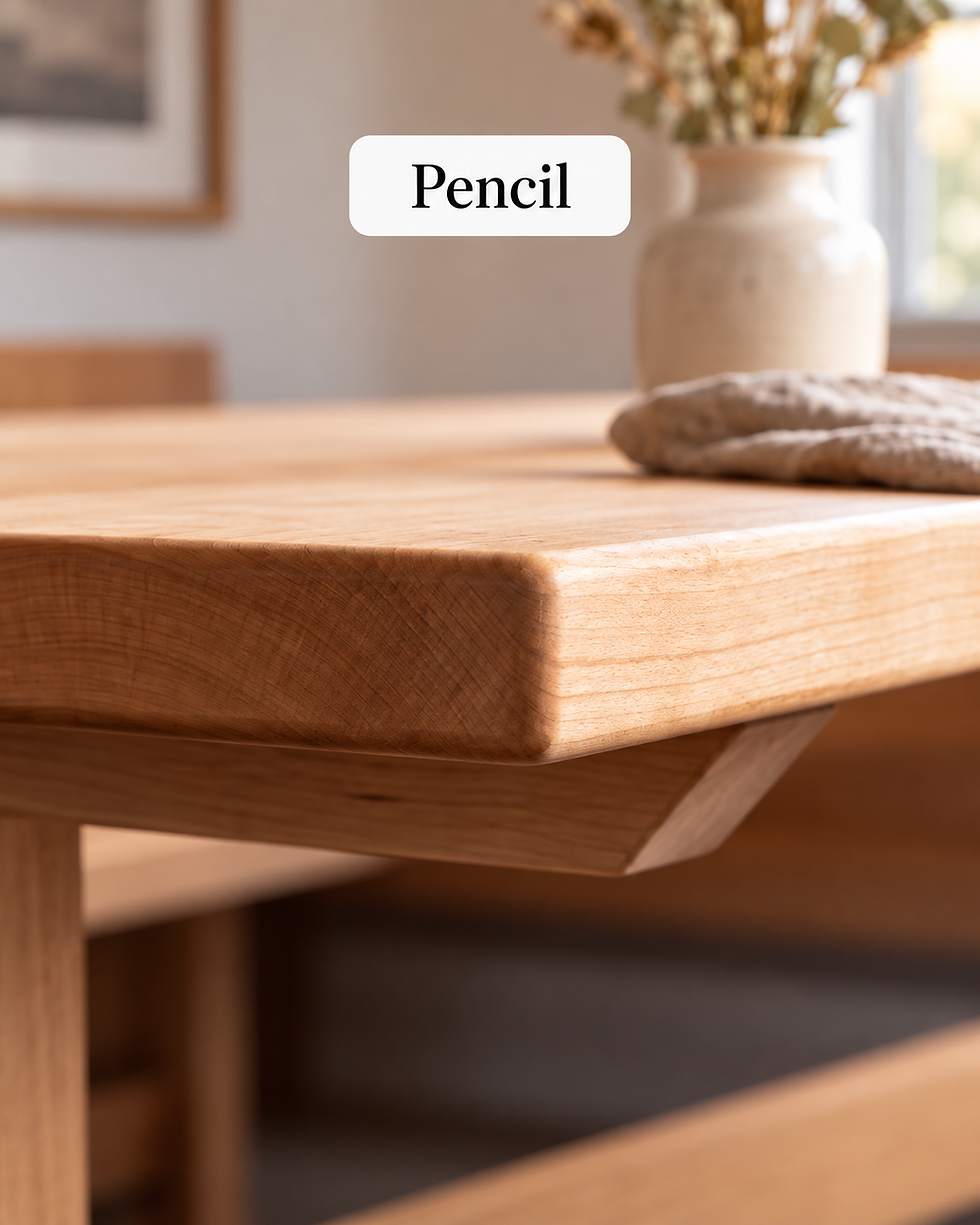
A pencil edge has a slightly larger radius than a typical eased edge. The corner is noticeably rounded, but the tabletop still maintains a relatively square appearance.
It gives the table a softer, more comfortable feel without making the edge look heavily rounded.
Best for: contemporary dining tables, family tables, desks, and pieces where you want clean lines with a softer touch.
The look: subtle, approachable, refined.
3. Bullnose Edge

A bullnose rounds the edge much more dramatically.
Instead of seeing a sharp transition from the top surface to the side of the table, the profile flows smoothly around the edge.
Best for: softer furniture designs, rounded tables, breakfast tables, kitchen tables, and pieces inspired by vintage or organic furniture.
The look: warm, substantial, soft.
Bullnose edges can be particularly beautiful on thicker solid wood tops because there is enough material for the curve to really show.
4. Double Bullnose

A double bullnose takes the rounded look even further, creating pronounced curves that can give the tabletop a heavier, almost sculptural appearance.
Depending on the exact profile, the edge can resemble stacked or flowing rounded sections.
Best for: statement tables, traditional furniture, vintage-inspired pieces, and thicker tabletops.
The look: substantial, decorative, luxurious.
This is the kind of edge that becomes part of the furniture's architecture rather than simply finishing the tabletop.
5. Chamfered Edge

A chamfer replaces a sharp 90-degree corner with a small angled surface.
It is one of our favorite ways to add detail without making a table feel overly decorative.
The chamfer can be very small and subtle or enlarged to make the edge a major design feature.
Best for: modern furniture, contemporary white oak tables, desks, consoles, and architectural pieces.
The look: crisp, intentional, tailored.
A chamfer is especially good when you still want the tabletop to appear substantial.
6. Beveled Edge

A beveled edge also uses an angled cut, but generally over a larger portion of the tabletop edge.
Depending on the direction and size of the bevel, it can either emphasize the thickness of a table or visually reduce it.
Best for: modern and transitional furniture.
The look: sharp, sophisticated, architectural.
This is one of those profiles where a small change in the angle can completely change the personality of the table.
7. Hollywood Bevel

The Hollywood bevel creates one of the most dramatic modern profiles.
The upper portion of the tabletop maintains enough thickness to still read as solid wood, while the underside angles back significantly.
From across the room, the tabletop can appear much thinner and lighter than it actually is.
Best for: contemporary dining tables, sculptural tables, pedestal tables, and designs where a lighter visual profile is desired.
The look: sleek, elevated, dramatic.
This works especially well on thicker tops because you get the structural mass of solid wood without visually carrying all of that thickness around the perimeter.
8. Sculpted Underside

A sculpted underside is less of a traditional router profile and more of a shaped tabletop.
Instead of simply rounding or beveling the corner, material is removed from the underside to create a smooth transition toward the outside edge.
This can make a heavy solid wood top feel surprisingly light.
Best for: organic-modern furniture, sculptural dining tables, custom statement pieces, and designs influenced by high-end contemporary furniture.
The look: handcrafted, organic, sculptural.
It is a beautiful option when you want someone to notice the craftsmanship as they move around the table.
9. Ogee Edge

An ogee uses a combination of concave and convex curves to create a decorative profile.
It has a much stronger traditional furniture influence than most of the other edges on this list.
Best for: traditional furniture, European-inspired tables, formal dining rooms, vanities, consoles, and furniture with classical detailing.
The look: traditional, ornate, furniture-like.
On the right piece, an ogee can look incredible. On a very modern table, though, it can feel out of place, which is why matching the edge to the overall design matters.
Which Table Edge Should You Choose?
There isn't one edge that works for every table.
For a clean modern white oak dining table, we might recommend an eased edge, pencil edge, chamfer, or Hollywood bevel.
For something softer and more organic, a bullnose or sculpted underside can completely change the feel.
And for a traditional or decorative piece, profiles like an ogee or double bullnose can add the architectural detail the design needs.
The important thing is that the edge should feel like part of the table rather than an afterthought.
At Native Rift, our tables are built from solid wood, which gives us considerably more freedom to shape, sculpt, bevel, and customize the tabletop than you typically have with mass-produced furniture.
If you're ordering a custom table and aren't sure which edge profile works best, send us a photo of the style you're after. We can help you choose a profile that fits the design.
Ready to Build Your Table?
Choose your wood, dimensions, finish, base, and edge profile, and we'll build the piece around your space.


Comments