
Rift Sawn vs Quarter Sawn vs Plain Sawn White Oak: What’s the Difference?

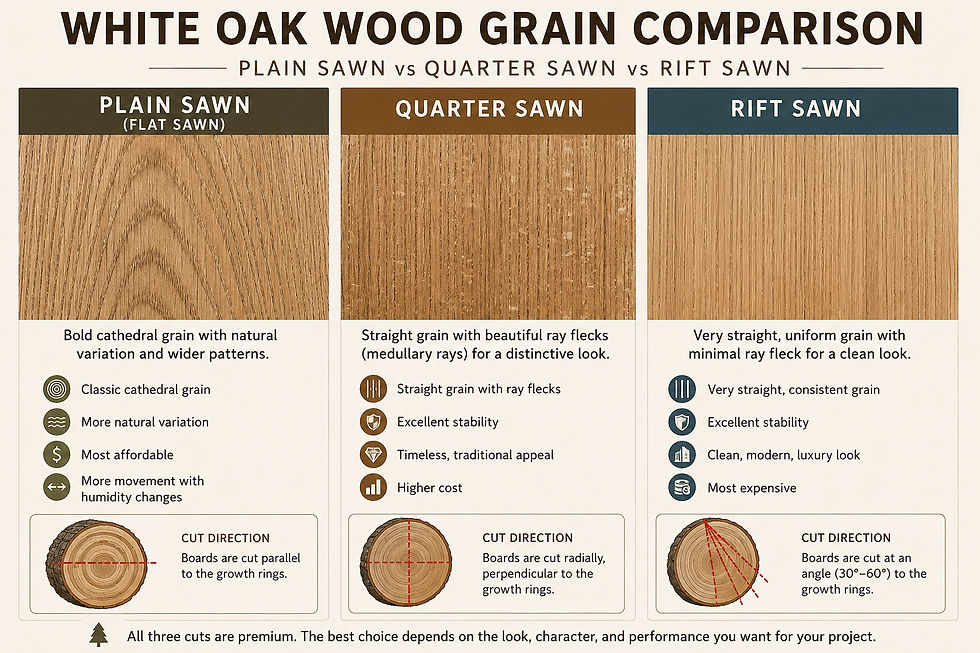
White oak has become one of the most sought-after hardwoods in modern home design. Whether you’re shopping for floating shelves, fireplace mantels, dining tables, or custom cabinetry, you’ve likely heard terms like rift sawn, quarter sawn, and plain sawn.
But what do these terms actually mean—and why do designers care so much?
The difference comes down to how the log is cut, which affects the grain pattern, stability, appearance, and overall character of the wood.
Understanding How White Oak Is Cut
Every white oak tree contains beautiful grain patterns. The way a sawmill cuts the log determines which grain patterns become visible on the finished boards.
There are three primary cuts:
Plain Sawn (Flat Sawn)
Quarter Sawn
Rift Sawn
Each offers a completely different look.
Plain Sawn White Oak
Appearance
Plain sawn white oak displays the classic cathedral-shaped grain pattern most people recognize.
The grain tends to be wider, more dramatic, and full of natural variation.
Pros
Most affordable option
Highest lumber yield from the log
Strong natural character
Traditional appearance
Cons
More prone to seasonal movement
Less consistent grain pattern
More variation between boards
Best For
Farmhouse furniture
Rustic interiors
Traditional homes
Projects where natural character is desired
Many homeowners love plain sawn white oak because every board feels unique and full of personality.
Quarter Sawn White Oak
Appearance
Quarter sawn white oak is cut so the growth rings are roughly perpendicular to the face of the board.
This produces a straighter grain pattern and reveals one of white oak’s most distinctive features: medullary ray flecks.
These shimmering ribbons create a unique figure that has been prized in fine furniture for generations.
Pros
Excellent dimensional stability
Reduced expansion and contraction
Beautiful ray fleck figure
Premium appearance
Cons
Higher cost
Lower yield from the log
More pronounced grain figure that isn’t for everyone
Best For
Mission-style furniture
Arts & Crafts furniture
Cabinetry
Built-ins
Statement pieces
Quarter sawn white oak has a timeless appearance that blends traditional craftsmanship with modern quality.
Rift Sawn White Oak
Appearance
Rift sawn white oak is cut at an angle that produces an exceptionally straight and uniform grain pattern.
Unlike quarter sawn lumber, rift sawn boards typically show very little ray fleck.
The result is a clean, consistent appearance that has become a favorite among architects and interior designers.
Why Designers Love Rift Sawn White Oak
Rift sawn white oak offers:
Consistent straight grain
Minimal visual distraction
Contemporary appearance
Architectural feel
Luxury aesthetic
Because the grain remains remarkably uniform from board to board, it creates a sophisticated and cohesive look throughout a space.
Pros
Excellent stability
Consistent grain pattern
Modern appearance
Highly sought after in luxury homes
Cons
Most expensive cut
Lowest lumber yield
Less readily available
Best For
Floating shelves
Fireplace mantels
Modern cabinetry
Contemporary furniture
Minimalist interiors
At Native Rift, rift sawn white oak is one of the most requested materials for custom shelves and mantels because of its clean, high-end appearance.
Stability Comparison
Wood naturally expands and contracts as humidity changes throughout the year.
When it comes to dimensional stability, the ranking generally looks like this:
Rift Sawn White Oak
Quarter Sawn White Oak
Plain Sawn White Oak
While all three cuts are durable, rift and quarter sawn lumber tend to move less over time, making them ideal for shelving, cabinetry, and furniture where straight lines matter.


Comments